
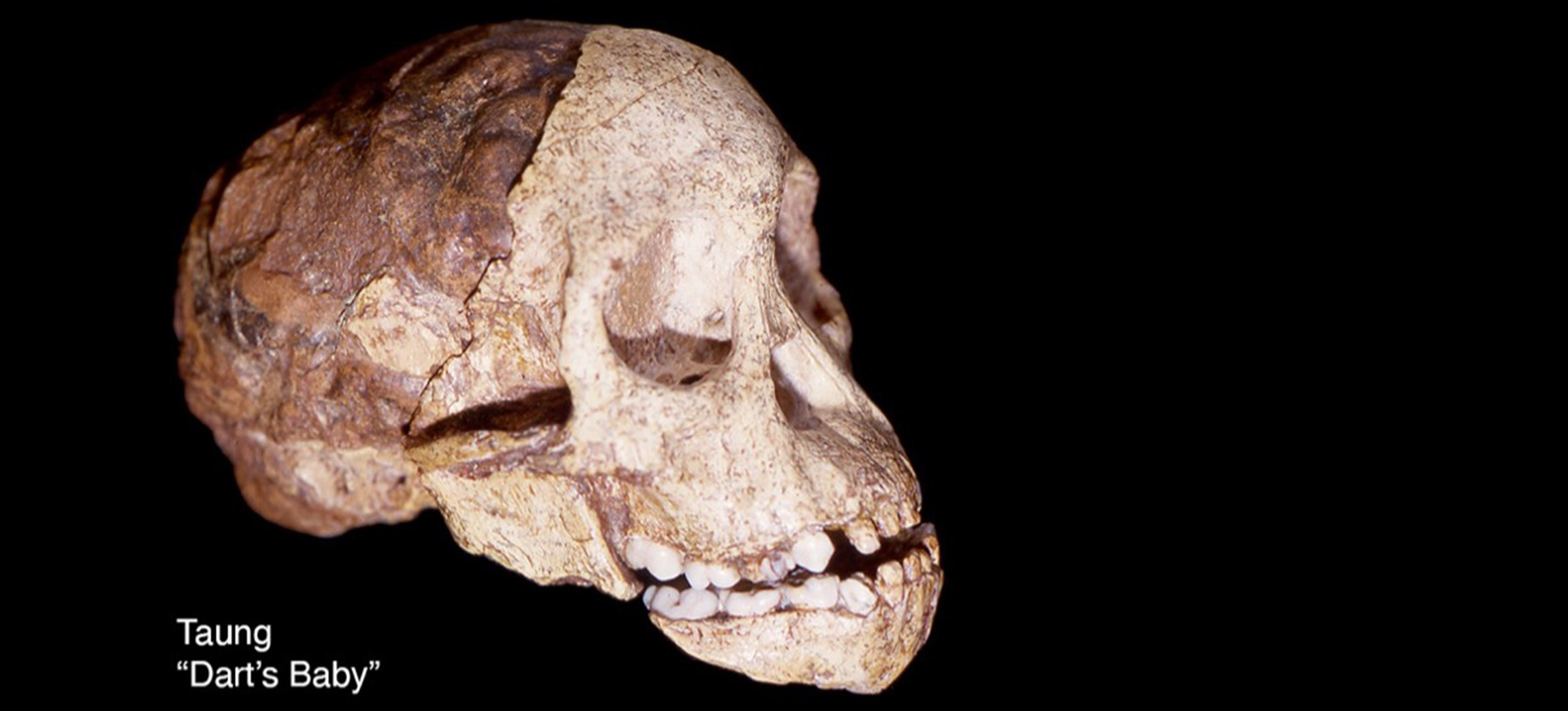
Australopithecus africanus
The first hominid discovery in South Africa in 1924 shocked the experts: until then it was believed that the cradle of mankind was in Europe or Asia.
Profile
|
Meaning of the name |
«Southern ape» from Africa |
|
Discovery site |
South Africa |
|
Age |
3.3–2.1 million years |
|
Height and weight |
♂: 1.40 m, 40 kg ♀: 1.1 m, 25 kg |
|
Brain size |
420 to 500 cm3 (larger than in modern apes, but smaller than in modern humans) |
|
Body characteristics |
Flat forehead, less prominent superciliary ridges than in earlier species, broad cheekbones, protruding jaw, funnel-shaped thorax, long arms, curved fingers, short legs, broad and short pelvis, head joint lies centrally below the skull (upright posture). |
|
Teeth |
Mixture of primitive and modern features; reduced canines, large flat molars indicate strong chewing muscles. |
|
Habitat |
Forests, savannah and bushland in South Africa. |
|
Nutrition |
A mixed diet of fruits, seeds, roots and possibly small animals. |
|
Tools |
No reliable evidence of tool manufacture. |
|
Best known find |
In 1924, Raymond Dart, who was then teaching at the University of Witwatersrand in Johannesburg, received a box of fossils from a limestone mine in Taung, a small town in South Africa. He noticed that one of the stones contained a small skull partially embedded in limestone. |
|
Special features |
The shape of the pelvis, the hip joint and the bones of the lower limbs indicate an upright, bipedal gait. The long arms and the curved finger bones suggest that Australopithecus africanus lived both on the ground and in the trees in the savannahs of South Africa. It probably lived in groups. |